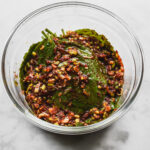
Korean Marinated Perilla Leaves (Kkaennip)
Make an easy and popular Korean side dish: Marinated Perilla Leaves or Kkaennip! Fragrant perilla leaves are soaked in a simple yet vibrant dressing. So fresh and herbal! So exciting and flavorful! A great side dish with any meal. Make sure to serve with rice for maximum enjoyment.
Servings: 30 leaves
Calories: 3kcal
Equipment
- Medium bowl
- Tupperware container with lid
Ingredients
- 30 perilla leaves
- 1/4 cup soy sauce
- 1 Tbsp Gochukaru *add 2 Tbsp for a spicier flavor
- 1/2 Tbsp sugar
- 1/2 Tbsp vinegar *rice vinegar, apple vinegar, or white distilled vinegar
- 2 green onion, minced
- 2 cloves garlic, minced
Instructions
- Wash leaves. Add perilla leaves to a large bowl. Wash in cold water to remove dirt and debris. Drain and stack perilla leaves on top of each other. Holding the stems, shake the perilla leaves to remove excess water. Set aside in a colander.
- Make soy sauce marinade. In a medium-sized bowl, add soy sauce, vinegar, gochukaru, sugar, green onion, and garlic. Stir briefly to combine.
- Dip perilla. Taking two perilla leaves at a time, dip each side into the marinade. Transfer the dipped leaves to a tupperware container. Continue to dip the leaves, two at a time, and add to the glass container. Make a neat stack with the stems pointing in the same general direction. When all the leaves are dipped, scrape the last of the marinade on top of the finished leaves.
- Store. Transfer to the fridge, tightly sealed, where it will keep for 1-2 weeks. For best results, marinate overnight in the fridge or at minimum, for 2-3 hours. It can be eaten immediately but the flavor won't be as strong.
- Serve. Serve with a bowl of rice and various other Korean side dishes. Enjoy!
Video
Notes
Tips:
- Point the stems in the same direction. When stacking the Korean perilla leaves together, it's helpful to have the stems pointing in the same direction. Makes the leaves easier to remove and eat.
- Stack the larger leaves on the bottom. Not all perilla leaves are the same size. Stack the larger leaves on the bottom and the small leaves on the top. They will be easier to remove and eat.
- How to eat Kkaennip: It's best to enjoy one individual leaf at a time. Grab the stem with chopsticks. Gently peel away the leaf. Place on top of rice. Using your chopsticks, grab a bundle of rice as you pick up the marinated leaf. Enjoy!
- Store in a table-ready container. There's no need to transfer the Kkaennip to another dish for serving. Instead, store in a container that can also be served at the table. I use a round glass tupperware container (pictured below). When ready to eat, simply remove the lid and serve, as is. A common Korean way to enjoy banchan at home.
Nutrition
Calories: 3kcal | Carbohydrates: 1g | Protein: 0.3g | Fat: 0.04g | Saturated Fat: 0.01g | Polyunsaturated Fat: 0.02g | Monounsaturated Fat: 0.01g | Sodium: 113mg | Potassium: 12mg | Fiber: 0.1g | Sugar: 0.3g | Vitamin A: 87IU | Vitamin C: 0.2mg | Calcium: 2mg | Iron: 0.1mg