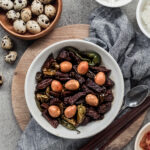
Korean Soy Sauce Braised Beef with Quail Eggs (Jangjorim)
A classic Korean side dish: Braised Beef with soy sauce. Also known as Jangjorim, my Korean grandma's recipe is made extra special with Shishito peppers and quail eggs. Salty, filling, beefy -- you'll reach for this dish again and again.
Servings: 6 as side
Calories: 236kcal
Equipment
- Stock pot
Ingredients
- 1 lb flank beef steak
- 2 cups water
- 18 quail eggs
- 8 oz/227 g Shishito peppers (about 2 cups)
Braising Liquid
- 1/4 cup soy sauce (not the low sodium kind)
- 1/4 cup Mirin
- 2 Tbsp sugar
Instructions
- Cut 1 lb flank steak into two equal halves, against the grain. Each half should be 2-3 inches long. Cover with cold water (about 2 cups) and boil for 30 minutes (covered) until a fork slides through with some resistance. The meat should not be bouncy or hard. But it shouldn't be completely tender either.
- Meanwhile, hard boil the quail eggs: cover with cold water and bring to a boil. Simmer for two minutes. Drain and immediately transfer to an ice water bath. Chill for 5 minutes. Peel eggs and set aside.
- When cool enough to handle, cut or shred beef into bite-sized strips. (The traditional way is to shred the beef by hand but my Halmoni cuts hers into neat strips, which is the way I like to do it as well. Cutting instead of hand shredding avoids stringy pieces of beef.)
- Add braising liquid: soy sauce, mirin, and sugar. Simmer (uncovered) for another 15 minutes until the beef is dark and there is just a little bit of resistance when you slide in a fork. Half the original liquid should be evaporated by now.
- Add shishito peppers and simmer (covered) until soft and deflated, another 10-15 minutes. By now, the beef should be tender with very little resistance. The liquid should be at 20% of the original volume.
- Add hard boiled quail eggs and cook another 5-10 minutes, making sure to spoon the braising liquid over the eggs.
- Serve warm, cold, or room temperature -- preferably with rice and other banchan. Enjoy!
Notes
*Jangjorim should last about 1 week in the fridge, tightly covered.
Nutrition
Calories: 236kcal | Carbohydrates: 9g | Protein: 20g | Fat: 14g | Saturated Fat: 6g | Polyunsaturated Fat: 1g | Monounsaturated Fat: 6g | Cholesterol: 274mg | Sodium: 701mg | Potassium: 259mg | Fiber: 0.1g | Sugar: 7g | Vitamin A: 158IU | Vitamin C: 0.2mg | Calcium: 27mg | Iron: 3mg